Protecting your business from defamation lawsuits is essential in today’s fast-paced digital world, where statements can spread instantly, and reputational harm can occur within minutes. Whether accusations appear in online reviews, social media posts, news articles, or competitor communications, false and damaging statements can disrupt operations, drive away customers, and expose your company to costly legal battles. Understanding how defamation works and how to protect your business against it is the first step toward safeguarding your brand and financial stability.
At Gross Law Group, our Melbourne, FL, business defamation attorneys help companies of all sizes anticipate risks, respond strategically, and defend their reputation with precision. Defamation claims often arise not only from external parties, but also from employees, former partners, and even vendors. With the right policies, training, and legal guidance in place, your business can significantly reduce its exposure to these claims.
This guide explains the key elements of defamation, provides everyday scenarios that can lead to lawsuits, and outlines the preventive strategies every business should implement. By taking a proactive approach and relying on experienced legal counsel, you can safeguard your company’s credibility, prevent unnecessary disputes, and ensure that your reputation remains one of your most valuable business assets. Call Gross Law Group today to begin protecting your business.
Key Takeaways About Business Defamation Lawsuits
- Businesses can face lawsuits for defamation by their competitors or even by customers.
- Although defamation lawsuits are not always easy to prove, they can pose significant risks for businesses, potentially exposing them to substantial liability.
- Having policies and procedures in place ahead of time and closely following them can help protect a business and prevent lawsuits from occurring in the first place.
- An experienced business defamation attorney can help draft these policies and procedures, providing your business with legal advice to prevent actions that may be defamatory.
What Is Defamation in the Business Context?
In the business context, defamation refers to false statements made about a company, its products, or its employees that harm the business’s reputation, cause financial loss, or damage professional relationships. Like personal defamation, business defamation can take the form of libel (written or published statements) or slander (spoken statements). Businesses rely heavily on their reputation for fostering customer trust, securing partnerships, and enhancing overall market value, so false or misleading statements can have severe consequences.
Examples of business defamation include a competitor falsely claiming that a company’s products are unsafe, spreading untrue allegations about unethical practices, or making false statements that an employee engaged in illegal or dishonest activity. Even a single misleading post on social media, if widely circulated, can lead to lost sales, damaged partnerships, or harm to the company’s public image.
To prove business defamation, a company typically must demonstrate that:
- The defendant made a false statement about the business.
- The defendant published or communicated the statement to a third party.
- The statement caused actual harm or financial loss; and
- The defendant acted negligently or with knowledge of the falsity, depending on the jurisdiction.
Businesses often pursue defamation claims to recover financial damages, protect their reputation, and deter further false statements. Working with an attorney experienced in business litigation is essential to evaluate the claim, gather evidence, and navigate the legal requirements to protect the company’s interests effectively.
Who Can Sue a Business for Defamation?
In the context of defamation, several parties may have the legal standing to sue a business for false statements that harm their reputation. Generally, anyone who can show that a company made a false and harmful statement about them to a third party may have a valid claim. The specifics can vary by jurisdiction, but the key principle is that the defamed party must have suffered measurable harm as a result.
Individuals can sue if a business makes false claims about their personal or professional conduct. For example, if a company publicly alleges that an employee or contractor engaged in illegal or unethical behavior, the affected person may bring a defamation lawsuit. Similarly, independent professionals, such as consultants or freelancers, may have claims if false statements damage their credibility or client relationships.
Other businesses or organizations can also sue for defamation if false statements about their products, services, or practices result in financial loss or damage to their reputation. For example, a competitor spreading untrue claims about a company’s products being unsafe or defective can face legal action.
To succeed, the plaintiff, whether an individual or a business, must generally prove that the statement was false, communicated to a third party, and caused harm, and in many cases, that the company acted negligently or knowingly spread false information.
Because defamation claims can be complex and involve careful documentation of damages, individuals and businesses alike often rely on experienced attorneys to evaluate the strength of their case, gather evidence, and pursue compensation while protecting their legal rights.
What Do Businesses Have at Risk in a Defamation Lawsuit?
In a defamation lawsuit, businesses face significant risks that can affect their financial stability, reputation, and operations. Unlike minor disputes, a defamation claim can have far-reaching consequences, particularly if the alleged statements are public, widespread, or involve serious allegations.
One of the most immediate risks is financial liability. If the court finds that a business made false and harmful statements about another party, the company may have to pay compensatory damages for actual losses, which can include lost profits, reputational harm, or the cost of repairing business relationships. In some cases, courts may also award punitive damages if they find the defamation to be willful or malicious, thereby significantly increasing the financial exposure.
A defamation lawsuit also puts a company’s reputation at stake. Legal proceedings are typically public, and media coverage or online discussion of the case can draw negative attention, affecting customer trust and investor confidence. Even if the business ultimately prevails, the mere association with a lawsuit can harm brand perception.
Operational risks are another concern. Defending against a defamation claim requires time, resources, and legal experience, which can divert management attention from core business activities. Small and medium-sized businesses may find this particularly burdensome. Moreover, ongoing litigation can impact employee morale, partnerships, and strategic relationships, as stakeholders may worry about association with a business embroiled in legal controversy.
For these reasons, businesses facing or potentially facing a defamation claim should seek the counsel of experienced lawyers early. Proactive defense strategies, including evidence gathering and careful communication, can help minimize financial exposure, protect the company’s reputation, and preserve long-term business stability.
Preventative Strategies for Businesses to Protect Themselves from Defamation Lawsuits
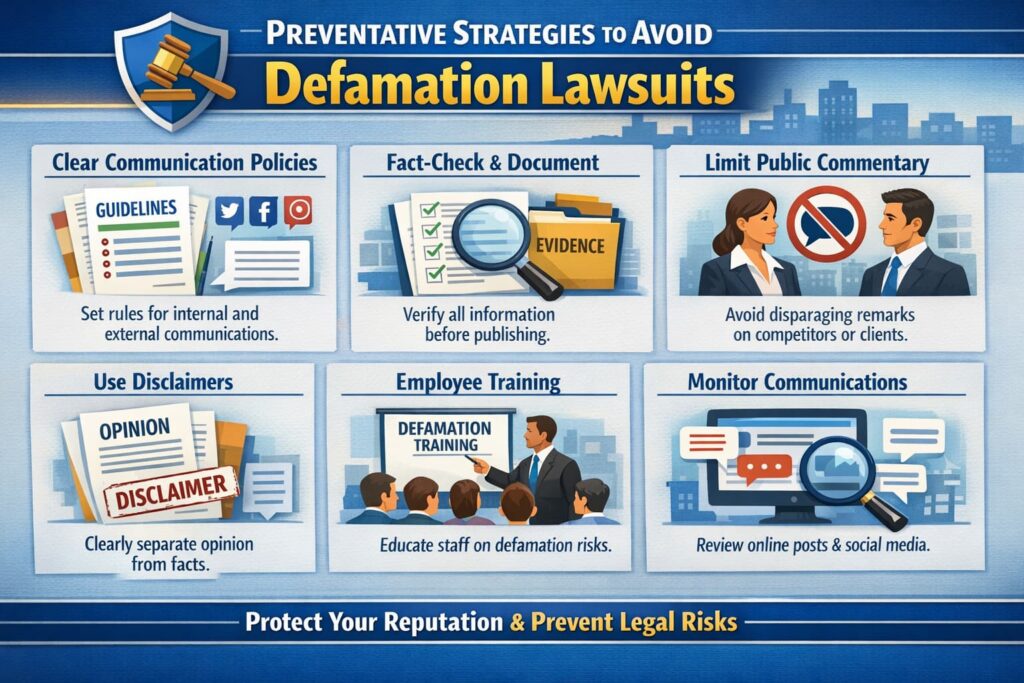
Businesses can employ several preventive strategies to protect themselves from defamation lawsuits, thereby minimizing legal risk and safeguarding their reputation. The goal is to promote careful communication, accurate documentation, and proactive policies that reduce the likelihood of making false or harmful statements about others.
- Implement clear communication policies: Companies should create guidelines for internal and external communications, including social media, marketing materials, press releases, and employee statements. Businesses should train employees to avoid making unverified or potentially harmful claims about competitors, clients, or partners.
- Fact-check and document information: Before publishing statements, ensure that verifiable evidence supports all claims. Maintain records showing that parties reasonably investigated and verified information, which can be critical if a defamation claim arises.
- Limit public commentary on competitors and clients: Avoid making comparative statements that may be disparaging. If comparisons are necessary, ensure they are truthful, objective, and based on publicly available or verifiable data.
- Use disclaimers where appropriate: When expressing opinions or sharing third-party information, clear disclaimers can help distinguish personal opinion from factual assertion, reducing potential liability.
- Train employees and management: Conduct regular training on defamation law, social media use, and proper communication practices. Employees are often the source of statements that may lead to legal claims, so education is crucial.
- Monitor communications: Regularly review public-facing content, including online reviews and social media posts, to ensure nothing unintentionally exposes the business to liability.
By proactively implementing these strategies, businesses can minimize the risk of defamation claims while maintaining credibility and professional integrity in the marketplace. A company should develop a plan in advance and adhere to it consistently throughout all its operations.
Businesses Should Rely on Policies and Procedures to Prevent Defamation Lawsuits
Businesses can significantly reduce the risk of defamation lawsuits by implementing clear policies and procedures that guide employees on how to communicate both internally and externally. Well-crafted policies establish expectations for accuracy, professionalism, and accountability, helping prevent statements that may be false or harmful.
One key approach is to develop a communication policy that outlines acceptable practices for marketing, social media, press releases, and interactions with clients or competitors. Businesses should instruct employees to verify facts before making public statements, avoid speculative or disparaging remarks, and follow approved channels for sharing sensitive information.
Another necessary procedure is pre-publication review. For statements about competitors, clients, or partners, businesses can require management or legal review to ensure claims are truthful and supported by evidence. This safeguard not only reduces the risk of defamation but also protects the company’s reputation.
Training and documentation are also critical. Regular employee training on defamation law and proper communication practices reinforces the importance of the policy. Documenting compliance with these procedures can serve as evidence that the business acted responsibly in the event of a legal claim.
By creating and enforcing structured policies and procedures, companies can foster a culture of careful communication, reduce legal exposure, and demonstrate that they take defamation risks seriously, ultimately protecting both their reputation and financial interests.
How a Melbourne, FL Defamation Attorney Can Help Your Business Prevent Lawsuits
A defamation lawyer can be an invaluable resource for businesses seeking to prevent lawsuits and protect their reputation. In today’s competitive business environment, even minor misstatements or unverified claims can lead to legal action, making proactive legal guidance essential.
One of the primary ways a defamation lawyer helps is by reviewing and drafting company policies related to communication. They will examine social media guidelines, marketing content, press releases, and internal communications. A lawyer ensures that these policies comply with defamation laws and clearly outline what employees can and cannot say publicly about competitors, clients, and colleagues. By providing structured guidance, businesses reduce the risk of employees unintentionally making statements that may lead to litigation.
Defamation attorneys also provide training and education for management and staff. They explain the legal boundaries of statements, what constitutes libel and slander, and how to verify information before making public claims. This training helps create a culture of careful and responsible communication, which is critical in preventing disputes.
Additionally, a defamation lawyer can review content before it is published, including marketing materials, website content, and social media posts, to ensure it is accurate and compliant with relevant laws and regulations. This pre-publication review identifies potentially harmful statements and provides strategies for rewording or adding disclaimers to minimize risk.
Finally, a defamation attorney can advise on crisis management and mitigation strategies if a potentially defamatory statement arises, helping the business respond appropriately before it escalates into a lawsuit. By combining preventive guidance, legal oversight, and education, a defamation lawyer enables companies to protect their reputation, mitigate liability, and operate with confidence in a competitive marketplace.
Gross Law Group helps Florida businesses that want to protect themselves from defamation lawsuits and fights for those who have already been facing lawsuits. To learn more about how we can help protect your business, contact us today.
Frequently Asked Questions About Defamation Lawsuits Against Businesses
What if the defamation statement is true?
Truth is a valid defense to defamation cases, as a party can only successfully sue you if the statement is false.
What if my business has received a cease-and-desist letter?
When you receive a cease-and-desist letter, you need to contact a defamation attorney to learn more about your path ahead.
Will a defamation lawsuit end up at trial?
Not all defamation cases will end up in court before a jury. It is possible to settle your case before trial, or the court may dismiss the lawsuit if the judge finds that it lacks merit.