Facing a DUI arrest in Melbourne, Florida, can be overwhelming, and the administrative Department of Motor Vehicles (DMV) hearing adds another layer of stress. Unlike your criminal case, the DMV hearing focuses solely on your driving privileges, determining whether to suspend or modify your license, or whether you may qualify for a hardship license. Because the rules, deadlines, and procedures are unique to the DMV process, preparation is critical.
A timely request for a hearing is crucial, as Florida drivers typically have only ten days from the time of arrest to act. Missing this deadline can result in an automatic license suspension, even if you later fight the criminal DUI charges. Preparing for the hearing involves reviewing police reports, chemical test results, refusal affidavits, and any available video evidence. It also requires understanding the key legal issues, such as whether the officer had lawful cause for the stop and whether they followed proper testing procedures.
An experienced Melbourne DUI lawyer at Gross Law Group can guide you through every step, helping gather evidence, challenge procedural errors, and present a strong case to protect your driving privileges. Proper preparation increases your chances of a favorable outcome and minimizes the impact on your mobility and daily life. To begin preparation for your DMV hearing, call us today to speak to a DUI attorney.
Key Takeaways About DMV Hearings
- You can request a DMV hearing under Florida law if you do so within ten days after your arrest.
- The DMV hearing is independent of your criminal case, and it relates to whether the department will suspend your license.
- You can also request a hardship license at a DMV hearing, depending on your circumstances.
- A DMV hearing is an administrative one, but it still requires evidence and testimony.
- Although a DMV hearing is a less formal proceeding, it is still essential to take the time to prepare for it.
- Contact a DUI attorney immediately, as you have a limited amount of time to request and prepare for a DMV hearing.
What Is a DMV Hearing in Florida?
A DMV hearing in Florida, or a formal or informal review hearing, is an administrative proceeding that addresses issues related to a driver’s license after a DUI arrest. This hearing is separate from the criminal court case, and the Florida Department of Highway Safety and Motor Vehicles (DHSMV) will handle the case. Its primary purpose is to determine whether to uphold, modify, or invalidate the driver’s license suspension following the arrest.
After a DUI arrest, Florida drivers typically face an automatic administrative license suspension for refusing a breath, blood, or urine test or for testing over the legal limit. The driver has only ten days from the date of arrest to request a DMV hearing; otherwise, the suspension will take effect automatically.
During the hearing, a hearing officer reviews evidence, including police reports, breath test results, and witness testimony. The issues the DMV will examine may include whether the officer had lawful cause for the traffic stop, whether the arrest was valid, and whether law enforcement followed proper procedures for chemical testing. Unlike the criminal court, the standard of proof is lower, and the rules of evidence are more relaxed.
A DMV hearing also provides an opportunity to request a hardship license, which may allow limited driving privileges for work, school, or medical needs. Because the outcome can significantly affect your ability to drive, legal representation can be critical.
What Is the Difference Between a DMV Hearing and a Criminal Case?
In Florida DUI cases, there is a significant distinction between a DMV hearing and a criminal court case, even though both may arise from the same arrest. A DMV hearing is an administrative proceeding that the Florida Department of Highway Safety conducts. Its sole purpose is to determine issues related to a driver’s license suspension, such as whether to uphold the suspension or whether the driver qualifies for a hardship license. It does not decide guilt or innocence.
A criminal case, on the other hand, takes place in criminal court and focuses on whether the driver committed a crime. The potential consequences include jail time, fines, probation, DUI school, community service, and a permanent criminal record. The standard of proof in a criminal case is much higher, requiring the prosecution to prove guilt beyond a reasonable doubt.
The procedures also differ. DMV hearings have relaxed rules of evidence, and a hearing officer makes the decision rather than a judge or jury. Criminal cases follow strict procedural and evidentiary rules and may involve motions, hearings, and a trial.
Importantly, the outcomes are independent of one another. A driver may win the DMV hearing and still face criminal penalties, or lose the DMV hearing but later have reduced or dismissed criminal charges. Understanding both processes is critical to protecting your driving privileges and your legal rights.
What Happens During a DMV Hearing
During a DMV hearing in Florida, a hearing officer from the Department of Highway Safety and Motor Vehicles reviews whether to uphold your driver’s license suspension following a DUI arrest. This administrative process is separate from your criminal court case and focuses solely on your driving privileges.
The hearing typically begins with the introduction of documentary evidence, such as the arresting officer’s report, breath or blood test results, refusal affidavits, and any available video footage. Unlike the criminal court, the rules of evidence are more relaxed, allowing certain documents to be admissible without live testimony.
The arresting officer may testify, either in person or by phone, and your attorney can cross-examine them. Key issues include whether the officer had a lawful reason to stop you, whether there was probable cause for the arrest, and whether they followed proper chemical testing procedures.
You or your attorney may present evidence and arguments in your defense, including witness testimony or challenges to the accuracy and legality of the evidence. After reviewing all information, the hearing officer issues a decision to sustain, invalidate, or modify the license suspension.
Evidence You Can Use in a DUI Hearing
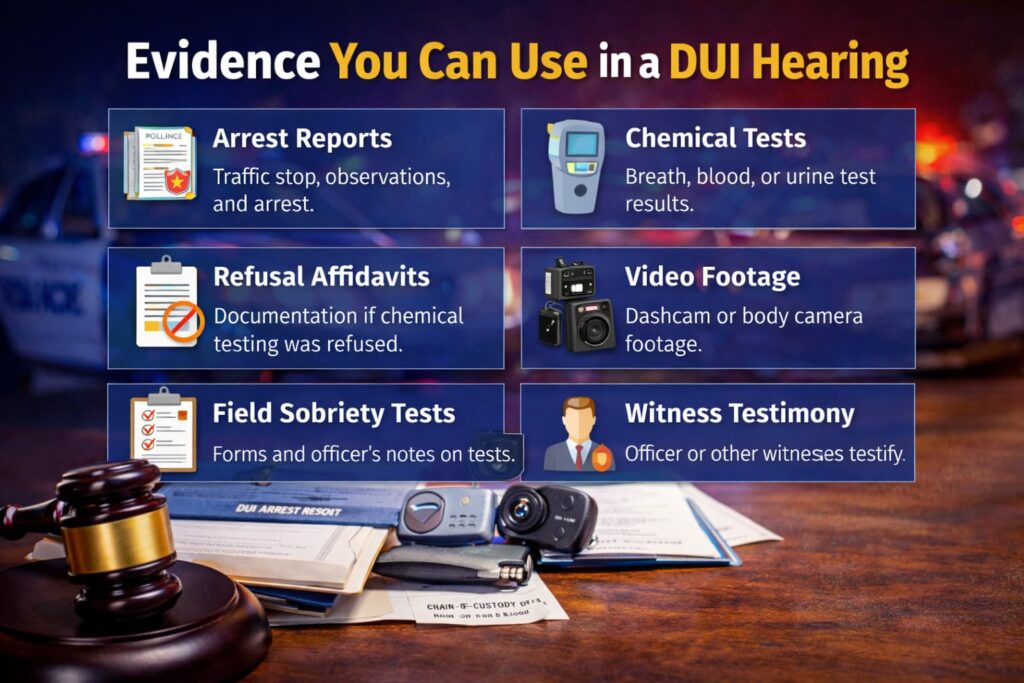
In a Florida DUI DMV hearing, the hearing officer reviews evidence to determine whether to uphold a driver’s license suspension. The evidence is generally more limited and informal than in a criminal case, but it can still have a significant impact on the outcome. Your DUI defense lawyer must quickly gather the evidence that you need for your case because the hearing may occur shortly after your initial arrest.
Common types of evidence include:
- Law enforcement reports, including the arrest affidavit and narrative describing the traffic stop, observations, and arrest.
- Breath, blood, or urine test results, along with maintenance and calibration records for breath-testing equipment.
- Required refusal affidavits if the driver allegedly refused chemical testing.
- Video recordings, such as dashcam or body camera footage, showing driving behavior or field sobriety tests.
- Field sobriety test documentation, including officer notes and standardized test forms.
- Witness testimony, typically from the arresting officer and occasionally from the driver or other witnesses.
- Traffic stop documentation, including reasons for the stop and probable cause for the arrest.
- Chain-of-custody records for blood or urine samples, when applicable.
Because DMV hearings follow relaxed evidentiary rules, you can use evidence that might not be admissible in criminal court. An experienced DUI lawyer can challenge the legality, accuracy, and reliability of this evidence to protect your driving privileges.
What You Can Do to Prepare for a DMV Hearing
Preparing for a Florida DMV hearing after a DUI arrest is critical, as the outcome can directly affect your ability to drive. One of the most important steps is to request a hearing within ten days of your arrest. Missing this deadline usually results in an automatic license suspension.
Next, gather and review all available evidence, including the arrest report, breath or blood test results, refusal affidavits, and any dashcam or body camera footage. Carefully examining these materials can help identify procedural errors or weaknesses in the state’s case.
You should also prepare to challenge key issues, such as whether the officer had lawful cause for the traffic stop, whether the arrest was valid, and whether they followed proper chemical testing procedures. If witnesses are available, consider whether their testimony supports your version of events. Another critical step is understanding your eligibility for a hardship license, which may allow you to have limited driving privileges for work, school, or medical purposes.
You Do Not Have Much Time to Prepare for a DMV Hearing
After a DUI arrest, one of the most stressful aspects of a DMV hearing is how little time you have to prepare. In Florida, drivers typically have only ten days from the date of arrest to request a DMV hearing. If you miss this deadline, the administrative license suspension automatically goes into effect, often leaving you without the ability to drive legally.
Once you request the hearing, you still have limited preparation time. You must quickly gather and review law enforcement reports, chemical test results, refusal affidavits, and any available video evidence. These materials can be technical and challenging to analyze without prior legal experience, especially when time is limited.
There is also a small window to subpoena the arresting officer or other witnesses, which is a critical step in many cases. If you do not issue subpoenas correctly or on time, you may lose the opportunity to challenge the officer’s testimony under oath.
Because DMV hearings move quickly and follow their own rules, delays can seriously harm your case. Working with an experienced DUI lawyer early can make a significant difference. A DUI attorney can immediately request the hearing, obtain evidence, identify weaknesses in the state’s case, and prepare compelling arguments, helping protect your driving privileges despite the tight timeline. Nonetheless, you cannot afford to wait too long to hire a DUI lawyer, given the accelerated timeframes for a DMV hearing.
How a DUI Lawyer Helps You in a DMV Hearing
A DMV hearing may seem like a minor administrative step after a DUI arrest, but it can have a significant impact on your daily life. The outcome determines whether the DMV will suspend your driver’s license, how long that suspension lasts, and whether you qualify for a hardship license. Because the rules and procedures differ from those in criminal court, having an experienced lawyer is often crucial.
One of the biggest reasons to hire a lawyer is the short deadline to request a DMV hearing. In Florida, you typically have only ten days from the date of arrest to act. An attorney ensures that you file the request on time and meet all procedural requirements.
A lawyer also knows how to challenge the evidence that may harm you. DMV hearings permit the admission of police reports, test results, and affidavits that may not be admissible in criminal court. An experienced DUI attorney can identify flaws in breath test procedures, equipment maintenance, chain of custody, or the legality of the traffic stop and arrest.
Additionally, a lawyer can subpoena and cross-examine the arresting officer, which is often the only opportunity to question the officer under oath before the criminal case. This testimony can strengthen your defense in court.
Ultimately, a DUI lawyer can assist you in pursuing a hardship license, which permits limited driving for work, school, or medical purposes. They can present your case to the administrative law judge to persuade them that you still need to drive for specific reasons. With so much at stake, legal representation can make a significant difference in protecting your driving privileges and your future. Call Gross Law Group as soon as possible to begin work on your DUI defense, both criminally and at a DMV hearing.
Frequently Asked Questions About DMV Hearings
Can I appeal the result of a DMV hearing?
You can file an appeal of a DMV hearing result through the court system.
Is a DMV hearing a requirement after every DUI arrest?
In Florida, a DMV hearing only occurs if the driver requests one within the required time frame.
Can I drive while waiting for the hearing?
If you request a timely DMV hearing within ten days, it is possible to keep your driving privileges until the completion of the hearing, depending on the circumstances.